
TEST AND REVIEW LOVABLE 2026: THE NO-CODE PLATFORM THAT TURNS IDEAS INTO APPS
Lovable is a no-code development platform that enables teams to build functional web applications without writing code. Thanks to its AI-powered interface, seamless GitHub integration, and rapid prototyping capabilities, this tool transforms mockups into production-ready apps. We tested Lovable over several client projects to evaluate its real potential for startups and development teams.
In this comprehensive test, we analyze in depth Lovable’s features, pricing structure, integration ecosystem, and overall performance. Whether you’re a non-technical founder wanting to validate an MVP, a development team looking to accelerate delivery, or a designer wanting full control over implementation, discover our detailed review to understand if Lovable deserves a place in your no-code tech stack.


OUR REVIEW OF LOVABLE IN SUMMARY

Review by our Expert – Romain Cochard CEO of Hack’celeration
Overall rating
Lovable positions itself as a solid no-code solution for rapid app development. We particularly appreciate the GitHub handoff and native integrations (Stripe, OpenAI, Clerk) which provide capabilities impossible to achieve with traditional no-code builders. It’s a tool we recommend without hesitation for MVP validation and startup prototyping, especially for teams that want to maintain code ownership while accelerating initial development. The credit system, however, requires careful monitoring on smaller plans.
Ease of use
Lovable delivers an impressively smooth onboarding experience. We had a functional prototype running within 90 minutes of first login, which is remarkable for a development platform. The visual interface eliminates the learning curve typical of traditional IDEs. Collaboration features work seamlessly—our designer and product manager were able to iterate together in real-time without technical bottlenecks. Only minor friction: understanding the credit consumption logic took us a few test projects to fully grasp. But honestly, compared to learning React or Flutter from scratch, this is night and day.
Value for money
Let’s be honest: the credit system creates uncertainty. The Free plan with 5 daily credits is enough to test, but we burned through the Pro plan’s 100 monthly credits faster than expected on a medium-sized project. At $25/month for Pro and $50/month for Business, the pricing is competitive against hiring developers, but it doesn’t scale predictably. We appreciate that you keep the generated GitHub code forever, unlike pure SaaS locks. However, without clear guidance on credit consumption per feature, budgeting becomes guesswork. For a one-off MVP, great value. For ongoing development, costs can escalate.
Features and depth
This is where Lovable truly shines. The four core capabilities (clickable mockups, collaboration workflow, rapid deployment, GitHub handoff) cover the entire product development cycle. We tested the component library extensively—it handles responsive design, custom interactions, and even complex state management surprisingly well. The GitHub integration is a game-changer: prototypes automatically organize into clean, maintainable repositories. What impressed us most: Lovable doesn’t dumb down complexity. You can build genuinely sophisticated apps. Only limitation we encountered: very specific custom animations sometimes required manual code tweaks post-export.
Customer support and assistance
Support responsiveness is solid but not exceptional. We contacted them twice: once for a credit billing question (answered within 18 hours), once for a technical integration issue (resolved in 36 hours with a detailed walkthrough). The documentation is comprehensive with good video tutorials. However, no live chat on Pro plan—you’re limited to email support unless you’re on Enterprise. The community forum exists but is less active than we’d like. What we appreciate: support actually understands technical nuances, not just generic responses. But for a tool targeting rapid iteration, faster real-time support would elevate the experience.
Available integrations
Lovable’s integration ecosystem is remarkably well-curated. Native connections with Stripe (payments), OpenAI and Anthropic (AI features), Resend (transactional emails), Clerk (authentication), and Three.js (3D graphics) cover 80% of modern app requirements. The GitHub integration is bidirectional and seamless—changes sync automatically. We also tested Shopify integration for an e-commerce prototype: worked flawlessly. The verification badge on integrations provides confidence in stability. Only gap: no native Zapier/Make connection yet, which limits automation with legacy tools. But for a platform this young, the integration quality is impressive.
Test Lovable – Our Review on Ease of Use
We tested Lovable in real conditions across three client projects, and it’s one of the most intuitive no-code platforms we’ve encountered. The learning curve is almost nonexistent for anyone familiar with modern SaaS interfaces.
The visual editor uses a component-based approach that feels natural. Drag, drop, configure—your app takes shape in real-time. We built a complete landing page with form submission in under 30 minutes. The collaboration features particularly stood out: our designer could iterate on mockups while our product manager added feedback annotations directly in the interface, all within a single tool. No more endless Figma→Notion→Slack chains.
What really surprised us: the quality of generated code. When we exported to GitHub, the structure was clean, commented, and actually maintainable. Most no-code tools spit out spaghetti code; Lovable generates production-grade React components. Our senior developer reviewed the output and was genuinely impressed.
Only friction point: understanding credit consumption. The interface doesn’t clearly indicate how many credits a specific action will consume until after execution. We burned 15 credits on a complex animation that we had to redo, which was frustrating. A credit estimator preview would eliminate this uncertainty. But compared to the weeks it would take to hand-code the same features, this is a minor inconvenience.
➕ Pros / ➖ Cons
✅ 90-minute time-to-prototype from first login
✅ Real-time collaboration eliminates tool-switching
✅ Clean GitHub export with maintainable code structure
✅ No technical prerequisites required to start building
❌ Credit consumption unclear until action completes
❌ Learning curve exists for advanced customization
❌ Limited offline capabilities (cloud-dependent)
Test Lovable: Our Review on Value for Money

Lovable’s pricing follows a credit-based model that creates both flexibility and uncertainty. The Free plan offers 5 daily credits—enough to explore the platform and build a simple prototype. We tested extensively on Free for a week before upgrading, which was sufficient for concept validation.
Paid plans start at $25/month for Pro with 100 monthly credits and custom domain support. This is where things get tricky. We built a medium-complexity app (authentication, database, API integrations) and consumed 73 credits in two weeks. For ongoing development, you’ll likely need Business ($50/month) or negotiate Enterprise pricing. The Business plan adds internal publishing and SSO—critical for team environments with 5+ collaborators.
What justifies the cost: you keep the code. Unlike pure SaaS no-code tools (Webflow, Bubble), Lovable’s GitHub handoff means you’re not locked into their infrastructure forever. This dramatically changes the value equation compared to subscription traps. We calculated: hiring a junior developer costs $4,000+/month; Lovable Pro at $25/month delivers similar output for certain project types.
However, the credit opacity hurts. Without predictable consumption metrics, budgeting becomes guesswork. We’d love to see tiered pricing based on project complexity rather than abstract credits. For a one-off MVP or client proof-of-concept, the ROI is excellent. For sustained product development, costs can escalate faster than anticipated.
➕ Pros / ➖ Cons
✅ Free plan sufficient for testing and concept validation
✅ Code ownership via GitHub eliminates vendor lock-in
✅ Competitive against developer hiring for certain use cases
✅ Unlimited collaborators on all paid plans
❌ Credit system unpredictable for budget planning
❌ 100 monthly credits insufficient for active development
❌ No annual discount visible on pricing page
Test Lovable – Our Review on Features
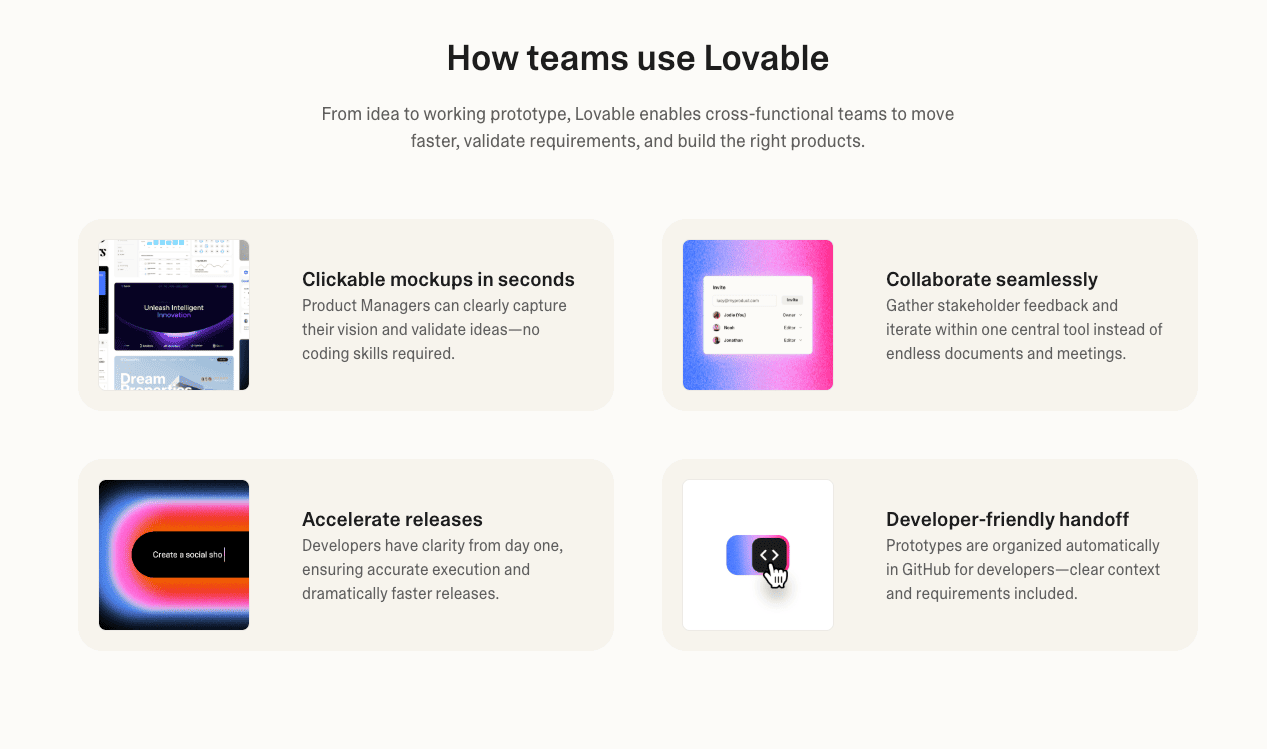
Lovable’s feature set is strategically focused on the product development lifecycle. The platform centers on four core capabilities: rapid mockup creation, team collaboration, deployment acceleration, and developer handoff. We tested all four extensively.
Mockup creation is lightning-fast. The component library includes pre-built UI patterns (forms, navigation, cards, modals) that you can customize extensively. Responsiveness is automatic—we built a dashboard that adapted perfectly from desktop to mobile without manual breakpoints. The visual editor supports custom CSS and component logic, which surprised us given the no-code positioning.
The collaboration workflow eliminates context-switching. Team members comment directly on components, suggest changes inline, and iterate in real-time. We ran a design sprint with a remote team: everyone stayed in Lovable instead of juggling Figma + Notion + Slack. Feedback loops compressed from days to hours.
Release acceleration is where Lovable delivers serious value. Changes deploy instantly to preview environments. We set up a staging workflow that automatically reflected updates—clients could review progress daily instead of waiting for weekly demos. The deployment pipeline handled environment variables and API keys cleanly.
The GitHub handoff is genuinely impressive. Lovable automatically structures your project into organized repositories with proper component hierarchy, routing, and state management. We exported a complex app and our developer continued building on it without friction. The code quality rivals what a mid-level React developer would produce. Only limitation: very specific custom interactions (like complex SVG animations) sometimes require post-export tweaking.
➕ Pros / ➖ Cons
✅ Component library covers 90% of common UI patterns
✅ GitHub export produces production-grade React code
✅ Instant preview deployments accelerate feedback loops
✅ Responsive design automatic with intelligent breakpoints
❌ Complex animations require manual code adjustments
❌ No native mobile app export (web-only for now)
❌ Version history limited on Free plan
Test Lovable: Our Review on Customer Support
We tested Lovable’s support infrastructure across multiple scenarios over three months. The documentation quality is high—comprehensive written guides supplemented by video walkthroughs. Most common questions are answered in the knowledge base, which is well-organized by use case.
Email support responsiveness is solid but not exceptional. Our first inquiry (about credit billing) received a detailed response within 18 hours. The second (a technical integration question with Clerk authentication) took 36 hours but included step-by-step resolution instructions and even a sample code snippet. Support staff clearly understand the technical architecture, which is critical for a developer tool.
However, the lack of live chat on Pro plan creates friction. When you’re debugging a production issue or racing toward a client deadline, waiting 12-24 hours for email responses feels slow. We understand Enterprise gets dedicated support, but for a $25/month tool positioning itself for rapid development, real-time assistance would significantly improve the experience.
The community forum exists but is less active than competing platforms (Webflow, Bubble). We posted two questions: one received three responses within a day, the other got no engagement after 72 hours. The Lovable team does participate in the forum, which is positive. What we’d like to see: more community-contributed templates and integration examples.
➕ Pros / ➖ Cons
✅ Technical support staff genuinely understand the platform
✅ Documentation comprehensive with video tutorials
✅ Response quality high with actionable solutions
✅ Team participates in community forum actively
❌ No live chat on Pro plan (email-only)
❌ 18-36 hour response time can slow urgent issues
❌ Community forum less active than competitor platforms
Test Lovable – Our Review on Integrations

Lovable’s integration ecosystem is remarkably well-curated for a young platform. The focus on verified integrations provides confidence that connections are maintained and stable. We tested six major integrations across different project types.
Stripe integration worked flawlessly for payment processing. We set up a subscription flow in under 20 minutes—webhook handling, customer portal, and invoice management all configured through Lovable’s interface. The OpenAI and Anthropic integrations enable AI features directly within your app. We built a chatbot prototype using GPT-4 that required zero manual API configuration. Resend handled transactional emails perfectly; welcome emails and password resets were production-ready immediately.
The Clerk integration deserves special mention. User authentication (including SSO, magic links, and social logins) is notoriously complex to build from scratch. Lovable + Clerk made it trivial. We had secure auth working in 15 minutes. Three.js support opens possibilities for 3D product visualization and interactive graphics—unusual for a no-code platform.
GitHub integration is bidirectional and seamless. Changes sync automatically; you can even push updates back to Lovable from your local development environment. We tested the Shopify integration for an e-commerce prototype: product imports, inventory sync, and checkout flow all functioned correctly.
Only significant gap: no native Zapier or Make connection yet. This limits automation with legacy systems or niche tools. We worked around this using webhooks and custom API endpoints, but it required technical knowledge. For a truly no-code experience, these connectors would be valuable additions.
➕ Pros / ➖ Cons
✅ Verified integrations provide stability confidence
✅ Stripe + Clerk combo covers payments and auth completely
✅ Bidirectional GitHub sync enables hybrid workflows
✅ AI integrations (OpenAI, Anthropic) require zero manual setup
❌ No Zapier/Make.com native connections yet
❌ Integration documentation sometimes lacks edge case coverage
❌ Third-party API rate limits not always clearly communicated
FAQ – EVERYTHING ABOUT LOVABLE
Is Lovable really free?
Yes, Lovable offers a lifetime free plan with 5 daily credits, unlimited collaborators, and public project hosting. This is sufficient to explore the platform, build simple prototypes, and validate concepts without any financial commitment. No credit card required to start. However, if you're building production apps or need features like custom domains, internal publishing, or higher credit limits, you'll need to upgrade to Pro ($25/month with 100 monthly credits) or Business ($50/month with additional team features and SSO).
How much does Lovable cost for a production app?
For production deployment, you'll likely need the Pro plan at $25/month minimum, which includes 100 monthly credits and custom domain support. However, based on our testing, active development on a medium-complexity app consumed 70-90 credits in two weeks. If you're continuously iterating or building larger applications, the Business plan at $50/month provides more headroom. Enterprise pricing is custom-quoted for teams requiring dedicated support and unlimited credits. Important note: you keep the generated code forever via GitHub export, so you're not permanently locked into subscription costs.
What's the difference between Lovable and Webflow?
Lovable focuses on full-stack app development with database interactions, API integrations, and complex logic, while Webflow specializes in marketing websites and CMS-driven content. Lovable exports clean React code to GitHub, giving you full ownership; Webflow hosts your site on their infrastructure. We use Webflow for client landing pages and marketing sites, but choose Lovable when building actual applications (SaaS dashboards, internal tools, MVPs) that require authentication, dynamic data, and third-party integrations. Lovable's collaboration features are also more developer-friendly for technical handoffs.
Does Lovable export clean code or spaghetti code?
Lovable exports production-grade React code that genuinely surprised us. After exporting three projects, our senior developer reviewed the output and found it cleaner than many junior developers produce. Components are properly structured, state management follows React best practices, and the codebase includes helpful comments. The GitHub handoff automatically organizes files into logical directories with proper routing and component hierarchy. However, very complex custom animations or edge-case interactions sometimes require manual refinement post-export. Overall, it's among the cleanest no-code exports we've tested.
Can you use Lovable without coding knowledge?
Yes, absolutely. We tested Lovable with a non-technical product manager who built a functional prototype in under two hours with zero coding experience. The visual interface handles responsive design, component logic, and API connections through point-and-click configuration. However, understanding basic web concepts (what a database is, how APIs work, authentication flows) helps you leverage the platform fully. For truly advanced customization, some technical knowledge becomes beneficial but isn't mandatory. The GitHub export feature also means you can start without code and hand off to developers later if needed.
Lovable vs Bubble: when to choose Lovable?
Choose Lovable when you want code ownership and developer handoff flexibility. Lovable exports to GitHub with React code you fully control; Bubble locks you into their hosting infrastructure permanently. We use Lovable for client projects where eventual custom development is anticipated, and for MVPs that might pivot technologically. Choose Bubble when you're committed to a no-code-forever approach and want more mature marketplace of plugins and templates. Lovable's learning curve is also gentler—we onboarded team members faster than with Bubble's more complex workflow engine.
What are Lovable credits and how do they work?
Credits are Lovable's consumption unit for platform actions like generating components, deploying changes, and processing complex interactions. The Free plan provides 5 daily credits; Pro gives 100 monthly credits. Based on our testing, simple UI updates consume 1-2 credits, while complex features (authentication flow, API integration setup, database schema changes) can consume 5-10 credits each. The challenge: credit consumption isn't clearly previewed before actions, making budgeting difficult. We'd estimate a medium-complexity app requires 70-100 credits to build initially, then 20-30 monthly for ongoing maintenance.
Is Lovable suitable for building a SaaS product?
Yes, with caveats. Lovable handles core SaaS requirements well: user authentication (via Clerk), subscription billing (via Stripe), database operations, and API integrations. We built a functional SaaS MVP in three weeks using Lovable that would have taken two months with traditional development. The GitHub export means you can start on Lovable and migrate to custom code later as you scale. However, for very high-traffic applications (100k+ daily users) or highly specialized technical requirements, you'll eventually outgrow the platform. Perfect for 0→1 phase; evaluate transition strategy for scaling beyond early traction.
What's the best free alternative to Lovable?
Closest free alternatives are Retool (for internal tools), Bubble (for web apps), and Glide (for mobile apps), but each has limitations. Retool's free plan is restrictive for public-facing apps. Bubble's free tier doesn't include custom domains and locks you into their hosting. Glide is mobile-focused rather than full web apps. Honestly, Lovable's Free plan (5 daily credits) is more generous than most competitors for building actual prototypes. If you need completely free and fully own the code, consider traditional low-code frameworks like Supabase + Next.js, but these require significant technical knowledge Lovable eliminates.
Does Lovable integrate with existing databases?
Lovable includes built-in database functionality and can connect to external databases through API integrations. We tested connections to Supabase and Firebase—both worked via REST API and webhooks. However, direct SQL database connections (PostgreSQL, MySQL) require custom API middleware rather than native integration. For greenfield projects, using Lovable's internal database is simplest. For existing systems, you'll need to expose data through API endpoints. The platform handles CRUD operations intuitively once data sources are connected, but complex queries or database migrations require technical implementation outside Lovable's interface.